NASA IMPACT · AI4Science · NASA MSFC at The University of Alabama in Huntsville

Sujit Roy

AI foundation models for science.

I'm a Lead AI Researcher on IMPACT's AI4Science team at NASA's Marshall Space Flight Center (MSFC), at The University of Alabama in Huntsville, where I lead the development of foundation models for NASA's Science Mission Directorate — currently focused on heliophysics and planetary science. With NASA and IBM Research, my teams built Surya, trained on the full Solar Dynamics Observatory archive, and Prithvi — open Earth-observation and weather–climate models now used across the community — with lunar and Martian-atmosphere models underway.

I came to space science through the brain: a PhD in computer science (UKIERI fellowship) at Ulster University with IIT Kanpur, advancing MEG- and EEG-based decoding of motor imagery for practical brain–computer interfaces, then explainable-AI research at the University of Manchester. Across ten years of ML R&D — and as co-founder of BrainAlive Research — the throughline is the same: models that learn the dynamics of physical systems, from cortical signals to solar storms. Current interests: generative modeling, computer vision, explainable AI, and reinforcement learning.

  • NASA Early Career Achievement Medal
  • AGU Open Science Award
  • 650k GPU-hour NAIRR allocation
Scroll to take the tour · click a world to fly straight to the work

01 · The Sun — 0.00 AU

Surya

A foundation model for heliophysics, trained on the full Solar Dynamics Observatory archive — every 12 minutes since 2010, 13 channels, 4096×4096 resolution. Long–short transformer architecture with frequency-based attention, scaled on HPC.

The Sun has been photographed every 12 minutes for 15 years. Surya is an AI that studied that entire archive and learned the Sun's behavior well enough to anticipate solar storms — eruptions that can scramble GPS, ground flights, and knock out power grids.
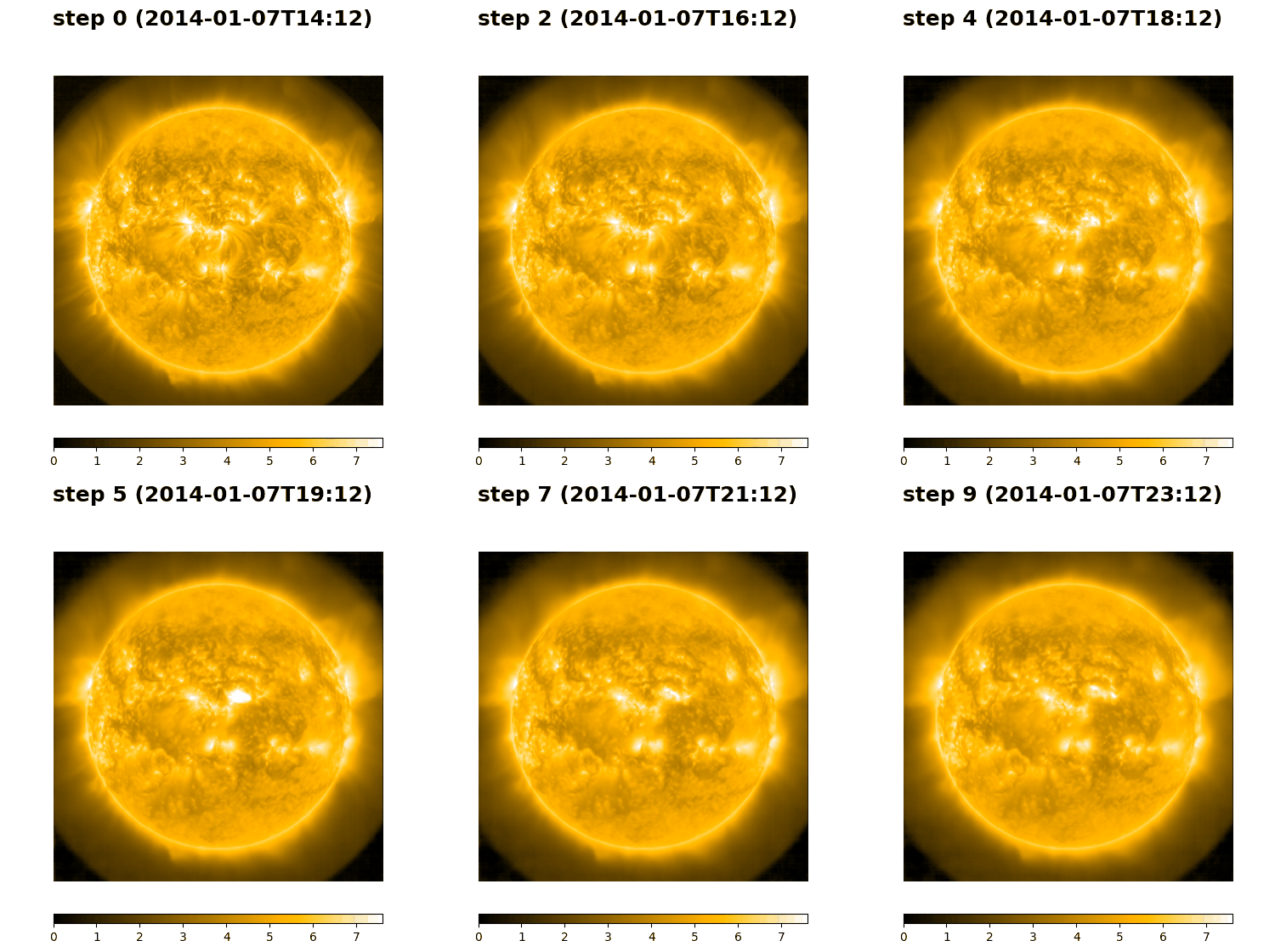
Animated rollout of Surya forecasting the Sun in AIA 171 ångström, stepping forward in time
Surya forecasting the Sun — an autoregressive rollout in AIA 171 Å, the model stepping the corona forward in time.
  • 366Mparameters
  • 13SDO channels · 12-min cadence
  • +16%flare-forecast skill vs prior SOTA

"It carries the imprint of late nights, stubborn bugs, and weekend experiments."

— on building Surya, NASA Science Data Portal

Architecture notes

SDO13 ch · 4096²patchifytokenslong · local attnwindowedshort · global attnstridedspectralfreq attentiondecodesolar state
  • Long–short attention keeps full-disk 4096² context tractable; spectral attention captures the Sun's periodic dynamics.
  • Pretext task: forecast the Sun's next state from every 12-minute frame since 2010.
  • Solar flare forecasting — SuryaBench finetunes for flare onset (Nature Scientific Data, 2026)
  • Solar wind & coronal holes — space-weather tasks under a 650k GPU-hour NAIRR allocation (≈$4.7M compute)
  • Active-region & magnetogram modeling — generalist SDO work presented at AIAA SciTech and NVIDIA GTC
02 · Earth — 1.00 AU · land

Prithvi EO

A geospatial foundation model built on ~4 petabytes of Harmonized Landsat–Sentinel imagery, generalized across downstream Earth-observation tasks — floods, burn scars, crops, land cover. AGU 2025 Open Science Award.

Satellites photograph every corner of Earth every few days. Prithvi EO learned from four petabytes of those images, so with a little extra training it can map a flood, trace a wildfire's scar, or identify crops — anywhere on the planet.

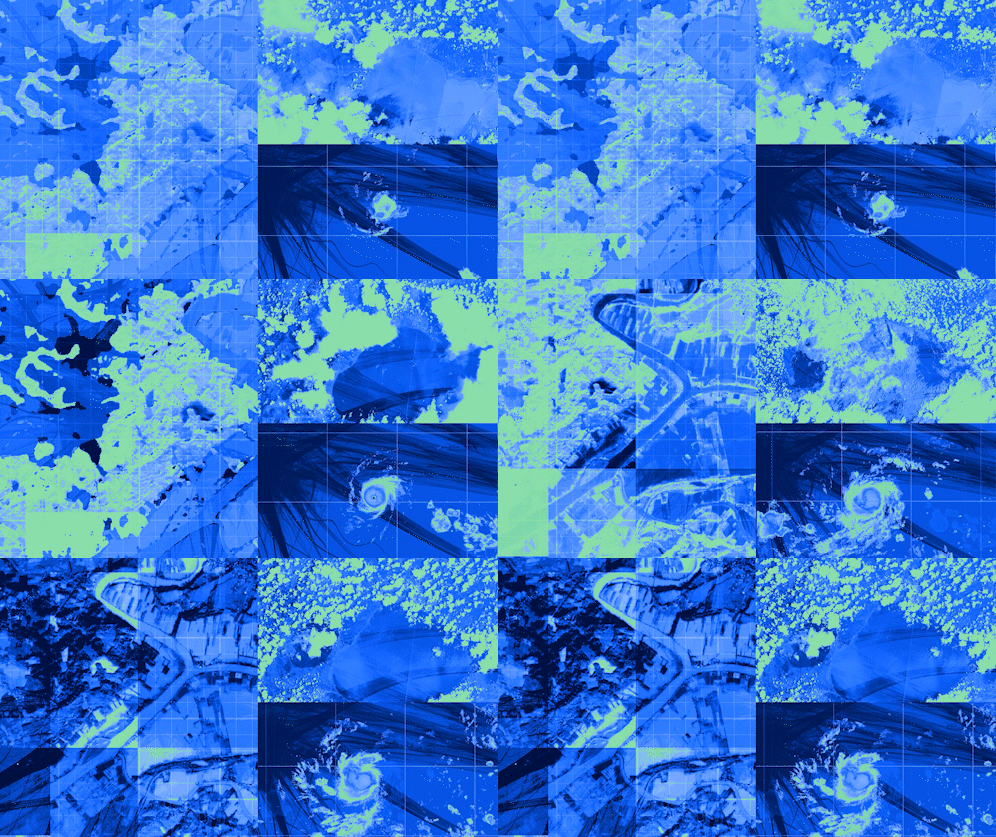
Animated visualization of Prithvi EO analyzing satellite imagery of Earth
Prithvi EO over the Harmonized Landsat–Sentinel archive. Animation: IBM Research blog.

Architecture notes

HLS time seriesmask ~75%ViT encodertemporaldecoderfloodsburn scarscrops
  • Masked-autoencoder pretraining on multi-temporal tiles: reconstruct the hidden 75% of Earth.
  • One frozen encoder, many lightweight task heads — the economics of foundation models.
  • Flood extent mapping — HLS fine-tunes that earned the NASA PLANET award and Center Honor Award
  • Wildfire burn scars — temporal segmentation of fire damage from orbit
  • 3D forest structure — AI + multi-modal satellite time series, NASA ROSES award ($798k)
  • Multi-sensor super-resolution — high-resolution alignment of satellite imagery (ICCV Workshops, 2025)

03 · Earth — 1.00 AU · atmosphere

Prithvi WxC

A weather and climate foundation model forecasting up to 160 atmospheric variables from MERRA-2, with neural-operator components for PDE-governed dynamics — the flow you see behind this panel.

A weather model that learned the behavior of the atmosphere from 40 years of NASA data — the swirling flow behind this panel. It sharpens hurricane forecasts and fills in the small-scale physics that climate models can't see.

Prithvi WxC predicting global 500 hPa winds — the same dynamics flowing behind this panel.

Architecture notes

MERRA-2160 varsencoderlatent rolloutneural operator · PDE dynamicsdecodert + Δforecast
  • Rollout happens in latent space; neural-operator blocks respect the PDE structure of atmospheric flow.
  • 2.3B parameters; one pretrained backbone serves forecasting, downscaling, and parameterization.
  • Hurricane track & intensity — AI forecasting of tropical cyclones (JAMES, 2025)
  • Gravity-wave parameterization — ML simulation of nonlocal propagation (ICML 2024) and two JAMES papers on subgrid-scale physics
  • Methods & benchmarks — Clifford neural operators for atmospheric PDEs and the WINDSET evaluation suite (ICLR 2024)

04 · The Moon — 1.0026 AU

Lunar foundation model

A mixture-of-experts + JEPA architecture with physically grounded tokenization: instrument-footprint positional embeddings and solar, emission, and phase angle embeddings.

Dozens of instruments have mapped the Moon, each seeing something different — temperature, minerals, terrain. This model fuses them into one understanding of the lunar surface, the way a geologist reads a landscape.

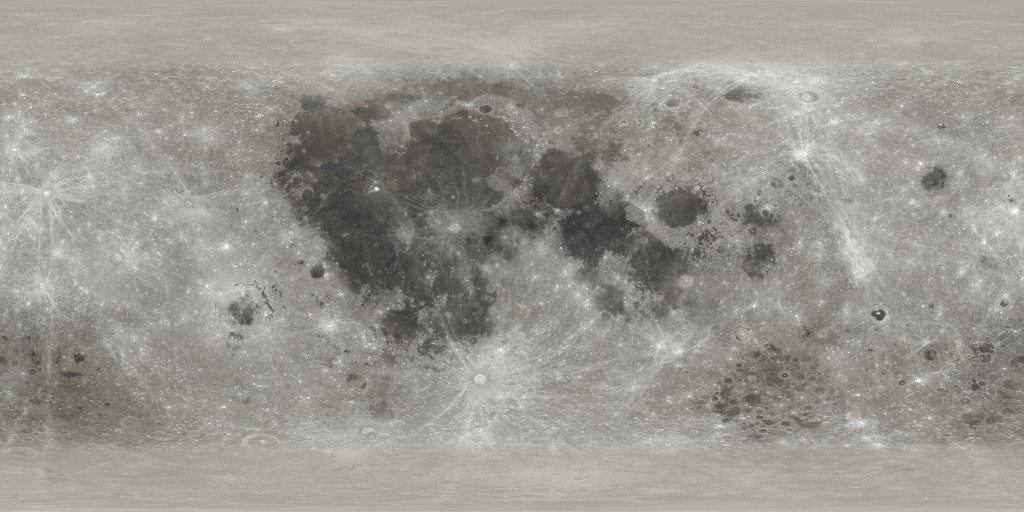
Lunar Reconnaissance Orbiter Camera color mosaic of the Moon
LROC WAC color mosaic — NASA SVS. Multi-instrument lunar data is the model's training domain.

Architecture notes

imagingthermalaltimetryrouterE1E2E…JEPApredict embeddingssurfacerepresentationtokens carry footprint + solar / emission / phase-angle geometry
  • Experts absorb instruments with incompatible footprints; JEPA predicts representations, not pixels.
  • Illumination geometry is explicit in the tokens — physics in, not bolted on.
  • Benchmark data descriptor — multi-instrument lunar ML dataset, in review
  • Physically grounded tokenization — geometry-aware embeddings for irregular orbital sampling

In development

05 · Mars — 1.52 AU

MAFM

The Mars Atmosphere Foundation Model. A perspective paper charts the path; the V0 proof-of-concept is in development with NASA, UAH, and IBM Research.

Mars has weather too — including dust storms that can swallow the entire planet. MAFM is the first step toward a weather forecaster for another world, built for the missions that will need one.


Valles Marineris hemisphere of Mars, Viking orbiter mosaic
The Valles Marineris hemisphere — NASA/JPL-Caltech. MAFM models the atmosphere above this terrain.

Architecture notes

OpenMARSorbiter obsGCM runscurriculumpretrainingMAFM V0in developmentdust stormscirculationEDL support
  • Curriculum runs from reanalysis to raw observations to simulation — data-poor compared to Earth, by design.
  • The real experiment: does the Earth-proven foundation-model recipe transfer to a thin CO₂ atmosphere?
  • Martian weather prediction — OpenMARS reanalysis, raw orbiter observations, and GCM simulation runs
  • Perspective paper — charting the path to a Martian-atmosphere foundation model (arXiv, 2026)

V0 in development

06 · Deep space

Beyond the planets

Quantum machine learning — structured quantum kernels for forecasting chaotic dynamical systems, localizing where quantum advantage appears in dynamical regimes.

Origins — a PhD in brain–computer interfaces at Ulster University with IIT Kanpur: decoding motor imagery from MEG and EEG in real time.

Two threads run outside the solar system: quantum computers learning to forecast chaos, and where it all began — teaching computers to read imagined movement from brain signals, a path toward communication for people who can't move or speak.

  • MEG imagery dataset — open motor- and cognitive-imagery BCI dataset (Nature Scientific Data, 2021)
  • ALS detection — 3D deep CNNs on resting-state MEG; Franklin V. Taylor Memorial Award + IEEE Brain Best Paper (IEEE SMC, 2023)
  • Cortical decoding — mapping engagement during motor imagery, mental arithmetic & silent word generation (Human Brain Mapping, 2023)
  • Learning analytics — CLEFT engagement model (IEEE Access) and the AMBS AI toolkit at Manchester
view

Telemetry 01 · Publications

Selected publications

Google Scholar ↗

    Telemetry 02 · Talks

    Invited talks & keynotes

    Telemetry 03 · Awards

    Awards & funding

    Telemetry 05 · Collaborators

    Built together

    The institutions behind the foundation-model papers — Surya, Prithvi, and the models underway.

    Telemetry 06 · Impact & press

    Impact & coverage

    460K+Hugging Face downloads, Prithvi EO family, 2025
    50+news outlets worldwide covered Surya's launch
    3open model families, free for anyone to build on

    Featured

    Global press

    Surya
    Prithvi

    Open models